IMPORTANT DISCLOSURES - PLEASE READ
This article is intended solely for educational and informational purposes and does not constitute investment advice, a research report, an offer, a solicitation, or a recommendation to buy, sell, or hold any security. The information presented is historical and illustrative, and based on publicly available sources believed to be reliable, but it has not been independently verified. Past performance is not indicative of future results. All investments involve risk, including the possible loss of principal, and no statement herein should be construed as a guarantee, prediction, projection, price target, or forecast of future performance. Historical returns and long-term return calculations discussed herein do not represent the performance of any actual client account and do not reflect advisory fees, brokerage commissions, bid-ask spreads, taxes, transaction costs, market liquidity, timing differences, or investor-specific circumstances. Certain illustrations, including long-term return calculations or hypothetical holding periods, are based on historical data and assumptions and are provided for informational purposes only. Securities discussed may be illiquid, thinly traded, volatile, difficult to value, and unsuitable for some investors. Readers should not rely on this article as the basis for any investment decision and should consult their own qualified financial, tax, and legal professionals before investing.
I was going through my files the other day and found an article that contained notes from the 1989 Berkshire Hathaway annual meeting.
At the meeting, a shareholder from Florida asked Warren, "Does it concern you that value investing has become so popular and there will be fewer good values to invest in?"
Here was Buffett's response:
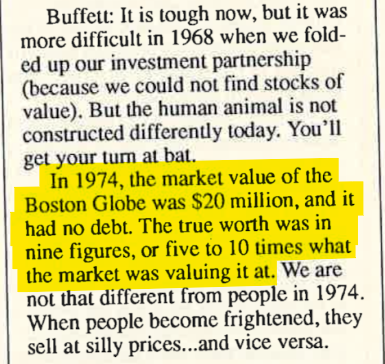
I thought it was interesting that, out of all the potential examples he could have used, Warren decided to highlight The Boston Globe as an outstanding investment opportunity in 1974.
A lot has been written about Buffett's other media investments, including The Washington Post, Cap Cities/ABC, and various advertising agencies. But I've rarely seen anyone discuss the details of The Globe investment.
So, I decided to pull the filings and see what the numbers actually looked like when Buffett was buying Affiliated Publications.
Background
The Boston Globe was founded by six local businessmen in 1872.
It struggled financially until Charles Taylor took over. Under Taylor's watch, The Globe became the dominant daily newspaper in New England. Taylor introduced various innovations such as Sunday editions, illustrations, and expanded advertising sections.
For most of its history, The Globe was a private company controlled by the Taylor family. Then in 1973 Globe Newspaper Company merged with Affiliated Publications and went public. Affiliated traded on the American Stock Exchange under the symbol AFP.
The Globe had six morning editions (Monday through Saturday), five evening editions (Monday through Friday), and a Sunday edition.
Boston at the time was a two-newspaper city. The other player of size was The Boston Herald. The Herald was founded in 1846, 26 years before The Globe. It was merged with numerous smaller papers over the years and was controlled by the Hearst organization in the 1970s.
Historically, The Herald cultivated a more populist style and eventually adopted the tabloid format in 1981, while The Globe developed a reputation as Boston's newspaper of record.
Buffett's Investment
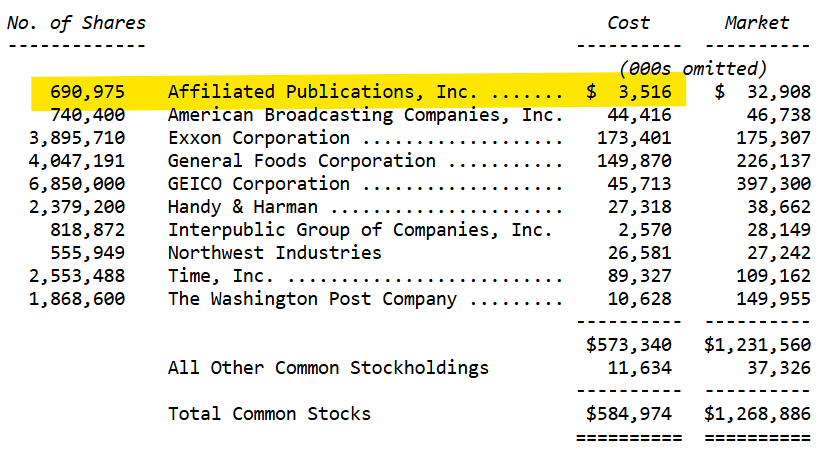
AFP first showed up in Berkshire's annual report in 1974 when it broke the $1 million market value reporting threshold.
Here was the valuation on AFP in 1974 when Buffett was buying it:
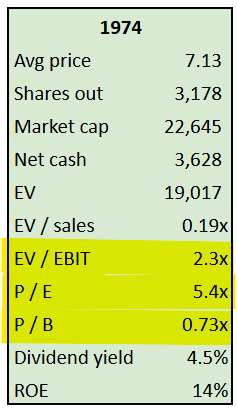
In addition to $3.6 million of net cash, AFP owned its 500,000 square foot facility in downtown Boston.
Here's the operational track record of Affiliated up to that point:
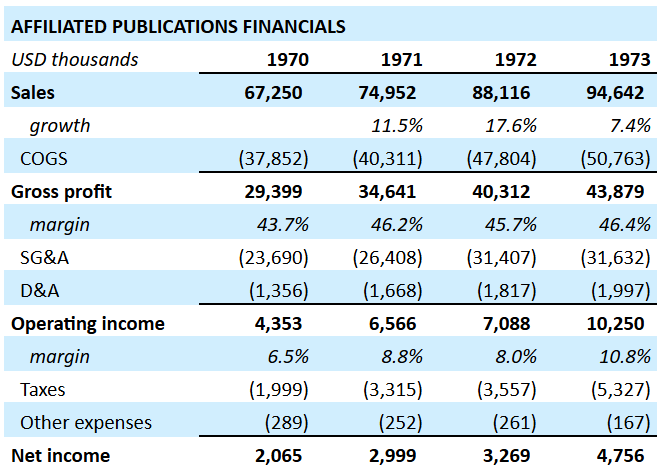
So, Buffett was paying 2.3x EV/EBIT, 5.4x P/E, and 0.73x P/B for a business that had doubled operating profits in the last three years and appeared to be performing well at the time. In that historical context, the price looked very low for a high-quality asset.
"The true value was in the nine figures, or five to 10 times what the market was valuing it at," as he said at the 1989 annual meeting.
A $100 million valuation would have equated to 9.4x trailing EV/EBIT and 21.0x P/E. I don't know if Warren actually thought The Globe was worth that much at the time or if it was hyperbole used in hindsight. Either way, AFP looked inexpensive based on the historical financial information available from that period.
Berkshire ended up acquiring 8% of Affiliated Publications in the mid-1970s for a total cost of $3.5 million.
What Happened Next
Affiliated grew both circulation and advertising revenue at a healthy rate while simultaneously expanding margins and producing ample free cash flow.
Revenue increased 12% per year from 1974 to 1985, and the operating margin expanded from 8% to 21%.
Free cash flow was used to pay dividends and make acquisitions. Around a quarter of the company's earnings were paid out in dividends, and the remainder was reinvested organically or in acquisitions. Affiliated bought a variety of media assets, including radio stations in New York, Ohio, and California, and a cable company in Oregon.
Returns on these purchases appear to have been satisfactory, as the company's overall return on equity increased from 14% in 1974 to 19% in 1985.
One acquisition that may have bothered Warren was the 1976 purchase of The Transcript in North Adams, Massachusetts.
AFP issued 200,000 shares for this acquisition, diluting shareholders by about 6%. I don't know what the valuation was on The Transcript, but AFP's stock was expensive currency, trading for an average P/E of 5x in 1976.
Here's a financial summary of the period:
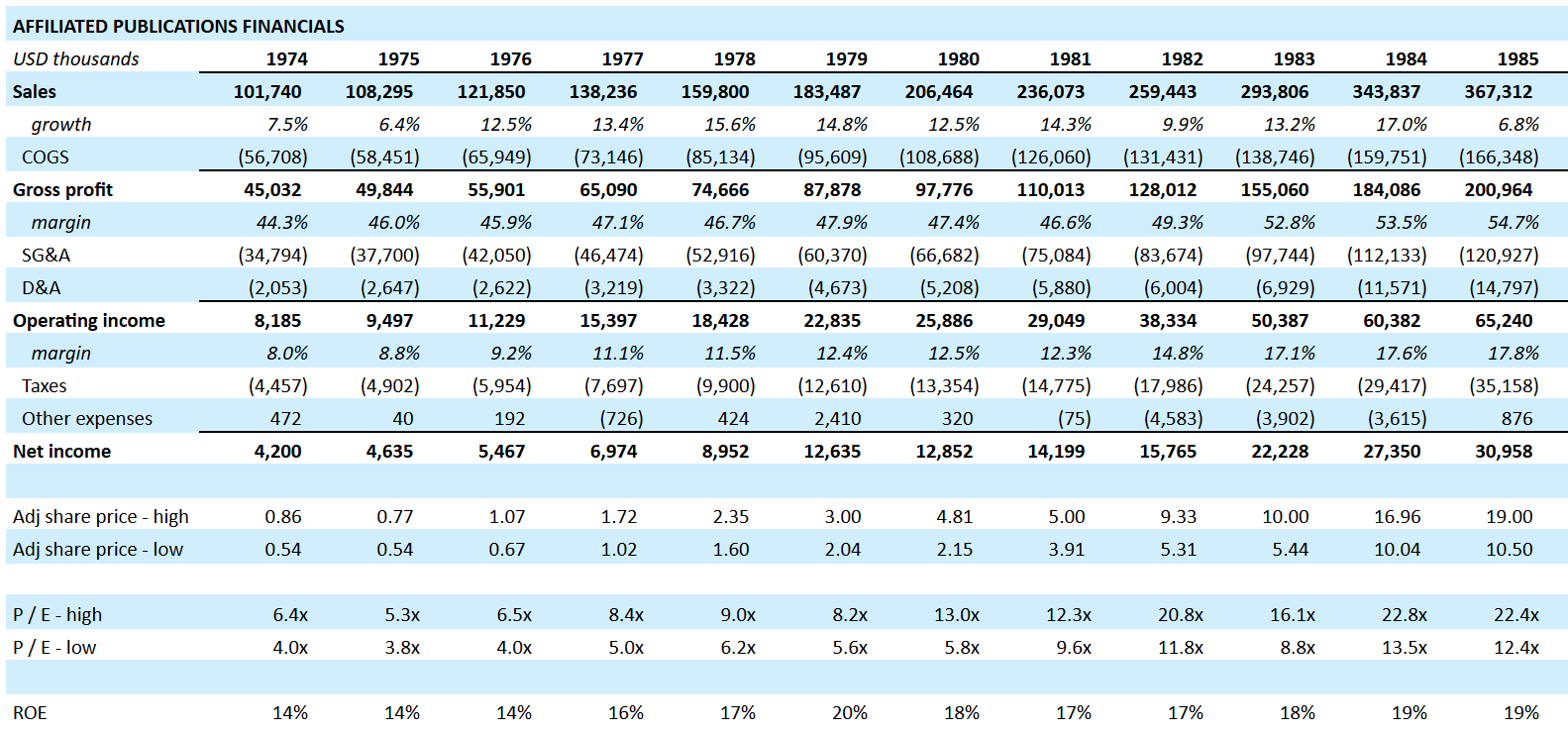
It's interesting to note that Affiliated didn't trade above 10x earnings until 1980. It could have been purchased at a single digit earnings multiple for six years from 1974 to 1979. And even after that point, it frequently traded back down into single digit territory.
Buffett Exits
Warren enjoyed the twin engines of earnings growth and multiple expansion.
EPS (adjusted for splits and stock dividends) grew from $0.13 in 1974 to $1.33 in 1985 (24% CAGR). Cumulative dividends paid were $1.35 per share (nearly 100% of the average adjusted share price of $1.41 in 1974). The stock traded for $48 in 1986 (36x P/E).
Berkshire's $3.5 million turned into more than $70 million (before dividends).
Based on those assumptions, I estimate his IRR on the initial 1974 purchases was around 44%, including dividends.
The investment ultimately worked out well, but the exit may be just as interesting as the purchase.
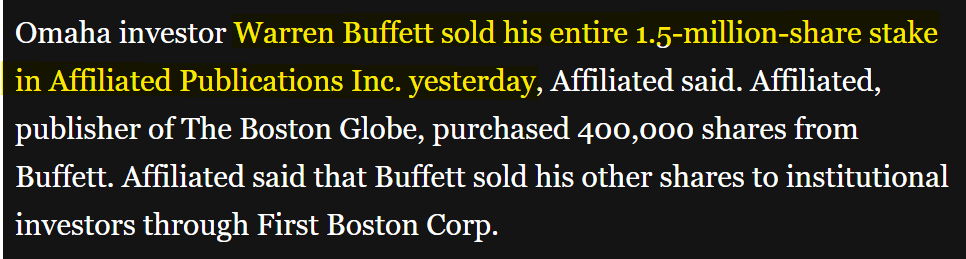
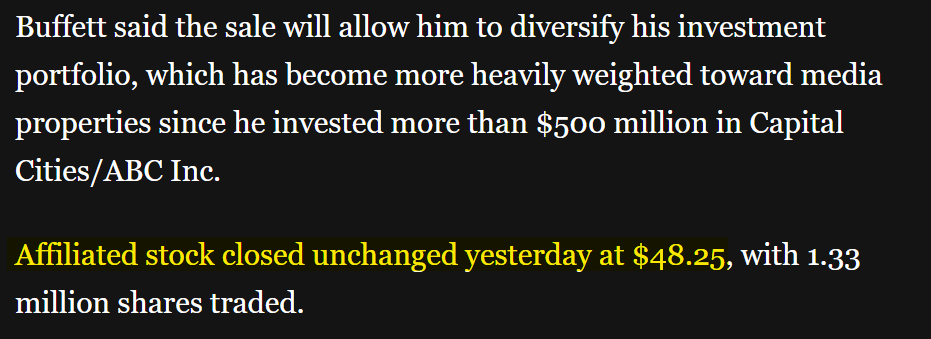
Buffett ended up selling his stake in 1986 back to the company and a group of other institutional investors. The public rationale for the sale was to diversify away from media, where Berkshire was already heavily invested. I suspect a bigger problem was that the valuation had grown too rich.
Here's how The Washington Post reported the sale at the time:
The New York Times purchased Affiliated Publications for $1.1 billion in 1993 (a similar valuation to Buffett's sale in 1986).
The newspaper business got significantly worse in the 1990s and 2000s, and The New York Times sold The Boston Globe to John Henry, owner of the Red Sox, in 2013 for only $70 million.
This represented a 94% decline in value over two decades and is a striking example of how technological change can reshape the economics of even once-dominant media assets.
Additional Regulatory Disclosures
Joe Raymond is a Registered Representative and an Investment Adviser Representative of Caldwell Sutter Capital, Inc. (CSC), Member FINRA/SIPC. This publication is for educational and informational purposes only and is not intended to be, and should not be interpreted as, investment advice, a research report under FINRA Rule 2241, an offer, a solicitation, or a recommendation to buy, sell, or hold any security. This publication has not been prepared as independent investment research and is not subject to the legal requirements applicable to independent research reports or related restrictions on trading ahead of publication. The views expressed are the author’s personal views and do not necessarily reflect the views of CSC. No compensation was received from any company mentioned herein, and the author’s compensation is not directly tied to the specific views expressed in this article. Affiliated Publications, Inc. is no longer publicly traded and is not available for investment. CSC, the author, associated persons, affiliates, and clients do not hold long or short positions in Affiliated Publications, Inc. This discussion is provided solely as a historical case study and should not be interpreted as a current opinion or recommendation regarding any security. Historical and hypothetical return illustrations do not represent actual account performance, are not representative of results achievable by other investors, and do not reflect advisory fees, brokerage commissions, bid-ask spreads, taxes, transaction costs, liquidity constraints, market liquidity, timing differences, or investor-specific circumstances. The securities discussed may be illiquid, thinly traded, volatile, difficult to value, and unsuitable for some investors. Investors should consult a qualified financial, tax, and legal professional before making any investment decision. This content is not directed to any jurisdiction where its distribution would be unlawful. Financial information referenced herein is derived from publicly available sources believed to be reliable, but CSC has not independently audited or verified such information.